
What Does "Grounded AI" Mean for Website Chat?
Grounded AI answers from your own content instead of general knowledge. What grounding is, why it matters, and how it differs from a general chatbot.
Grounding, in one sentence
A grounded AI answers from content you supplied, rather than from whatever the underlying model happens to have learned. That is the whole idea, and everything else in this guide is a consequence of it.
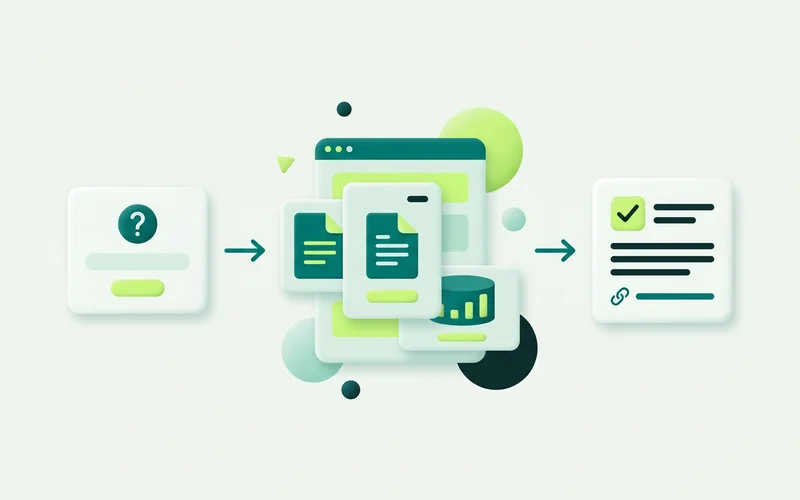
The mechanism is retrieval. When a visitor asks a question, the system first searches your knowledge base for passages relevant to it. Those passages are handed to the model along with the question, and the answer is built from them. The model is doing the writing; your content is doing the knowing.
Why it matters for a business website
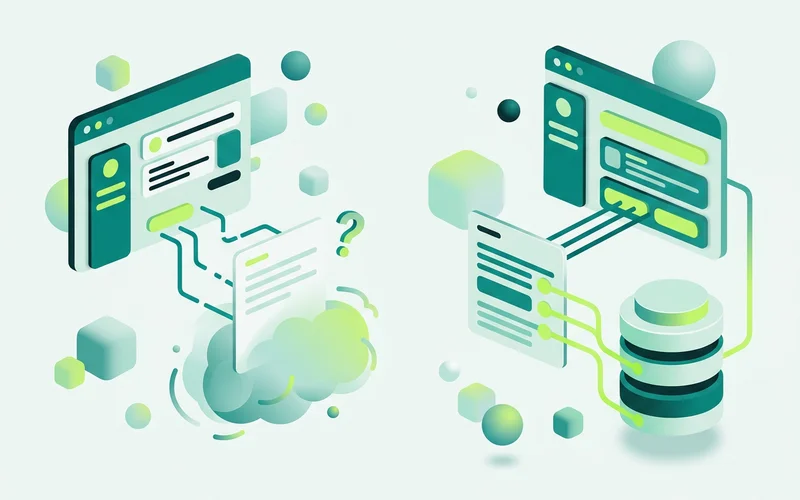
A general-purpose model has never seen your price list. Ask it what you charge and it will produce a number anyway, because producing a fluent answer is what it was built to do. It is not lying. It has no concept of your business to be wrong about. It is filling a gap the only way it can.
For a website chat that is a problem with real consequences. Customers arrive quoting prices you never set. People are told you cover an area you do not serve. Nobody notices until someone turns up expecting something.
Grounding changes the failure mode. When the knowledge base has the answer, the visitor gets it. When it does not, the system knows it does not, and you get to decide what happens next instead of getting a guess. That decision, refuse, escalate, hand off, is the part that makes AI usable on a page where people are trying to buy something.
How it differs from a general chatbot
| General chatbot | Grounded agent | |
|---|---|---|
| Source of facts | Model’s training | Your knowledge base |
| Unknown question | Generates something plausible | Can return your refusal message |
| Updating the answers | Reword the prompt and hope | Edit the source and reindex |
| Showing where it came from | Not possible | Optional source attribution |
| Who controls scope | The model | You, through mode and content |
The row that matters most is the second one. Everything else is convenience; that one is trust.
What you supply, and how
In the Grounded AI Agent & Knowledge Base you add knowledge three ways: paste text directly, upload PDF, DOCX, TXT, Markdown or CSV files, or import the readable text of one public web page by URL. Sources show a processing status, and you can edit the text, reindex a source after a change, or delete it.
Two boundaries worth knowing before you plan a migration. A URL import handles one page. There is no full-site crawl and no continuous website sync, so add the pages that carry answers rather than pointing at a domain. And scanned PDFs need OCR before import, since built-in OCR is not part of the product.
How tightly it stays inside your content
Grounding is not binary. onmsg offers three modes. Strict checks for relevant knowledge and can return a configured refusal without calling the answer model when nothing suitable is found. Balanced prefers the knowledge you supplied and instructs the model not to invent business facts. Open allows a more general conversation without the retrieval gate. Retrieval strictness is adjustable on top of the mode, so you can decide how closely a passage must match before it counts as relevant.
Most businesses end up with Strict on anything involving price, availability or a promise, and Balanced elsewhere.
The honest caveat
Grounding controls reduce the chance of a fabricated answer. They do not guarantee every response, and no configuration in any product does. Retrieval can surface a passage that is relevant but outdated. A question can be ambiguous enough that the right passage answers the wrong reading of it.
That is why grounding and escalation belong to the same feature. A configured refusal message, handoff after a set number of refusals, turn limits and timeouts are not bolted-on safety theatre. They are what makes a grounded agent safe to put in front of customers.
What grounding does not fix
Grounding controls the source of an answer. It does not control everything else, and being clear about that is what stops disappointment later.
Ambiguous questions. “How much?” retrieves something plausible whether or not it retrieves the right thing. Grounding does not disambiguate intent; a well-built flow that asks which service they mean does.
Outdated content. If your knowledge base still contains last year’s prices, retrieval will find them confidently. Grounding anchors the answer to your content, including the parts of your content that are wrong.
Contradictions. Two sources disagreeing means retrieval picks one. Grounding will not tell you they conflict.
Tone. A grounded answer can still read coldly. That is a matter of instructions and the source material’s own voice.
All four are content problems rather than model problems, which is good news: they are fixable by someone reading the knowledge base, not by waiting for a better model.
How to tell whether grounding is working
Three checks, none of which need tooling.
Ask something you never documented. In Strict mode you should get your refusal message, not an answer. If you get an answer, the mode is not what you think it is.
Ask something you documented recently. You should get it, phrased naturally. If it refuses, retrieval strictness is too tight or the source uses different vocabulary from the question.
Ask something two sources disagree about. Whatever comes back tells you which source is winning, and that is usually the moment you discover a conflict you did not know existed.
Run these after any significant change to the knowledge base. They take five minutes and catch most of what would otherwise reach a customer.
Read next: Strict, Balanced and Open grounding modes compared, or how to add your business knowledge.
Learn more about Grounded AI Agent & Knowledge Base
An AI agent that answers from your own knowledge base, with grounding modes, configurable refusals, and handoff to a person.
Questions people ask about this
Does grounding stop all mistakes?
No. Grounding reduces off-topic and invented answers and gives you a designed fallback when nothing relevant is found. It guides behaviour rather than guaranteeing every response, which is exactly why the refusal message and the human handoff exist.
Where does the AI get its facts?
From the knowledge you add: pasted text, uploaded PDF, DOCX, TXT, Markdown or CSV files, or the readable text of one public page imported by URL. Retrieval pulls from that content when answering.
Can it show its source?
Optional source attribution can show where an answer came from, which is useful when someone on your team is checking what the chat has been telling people.
Related guides
How to Add Your Business Knowledge: Paste, Upload and URL Import
Supply knowledge by pasting text, uploading PDF/DOCX/TXT/Markdown/CSV, or importing one public web page. See processing status, reindex and edit sources.
Read guideHow to Reduce AI Chatbot Hallucinations with Grounding Controls
Why chatbots invent facts, and how strict retrieval gating, refusal thresholds, handoff and source attribution help reduce it, controls that guide behaviour.
Read guideStrict, Balanced and Open Grounding Modes Compared
Compare onmsg's grounding modes: Strict (refuse when no relevant content), Balanced (prefer your knowledge), and Open (general conversation), plus when each fits.
Read guideWebsite Data Privacy: What Visitors' Chat Data Means for GDPR and CCPA
What chat and enquiry data is collected, how retention settings differ by plan, and general GDPR/CCPA considerations for chat intake, guidance, not legal advice.
Read guideWant to try this on your own site?
No credit card required.