
Handle Website Enquiries Without Extra Headcount
Deflect repetitive questions with grounded AI, capture context before handoff, and use a shared inbox for the conversations that need a person.

The problem is repetition, not volume
Small teams rarely drown in hard questions. They drown in the same four easy ones. What are your hours over the break, do you cover this area, how much is a callout, how long does a job usually take. Each answer takes ninety seconds. Twenty of them takes half a morning, and it is a half-morning that produces nothing except a slightly slower reply to the enquiry that actually mattered.
Hiring for that is expensive and, for most businesses, unnecessary. The work is repetitive because the answers already exist. They are in your FAQ page, your quote emails, and your head. The task is not to answer them faster. It is to stop answering them personally.

Step one: put your answers somewhere the chat can reach
Start by collecting what you already have. Paste your FAQs, upload your service documents as PDF, DOCX, TXT, Markdown or CSV, or import the readable text of a public page by URL. That becomes the knowledge base the Grounded AI Agent & Knowledge Base draws on.
The important part is where the answers come from. A general AI chatbot will answer your callout-price question by inventing a number. A grounded one retrieves from your content first, and in Strict mode it checks for relevant knowledge and can return a refusal message you wrote when it finds nothing suitable. For a small business, that refusal is the feature. It means the worst case is “I can’t confirm that, let me get someone”, not a quoted price you never agreed to.
A note on scope so you plan properly: a URL import handles one page rather than crawling your whole site, and scanned PDFs need OCR before import. Add the pages that carry the answers rather than expecting a sweep. If you are still deciding which channel should carry this work, our comparison of live chat, AI chatbots and contact forms sets out what each one is good at.
Step two: capture context before anyone gets involved
The second time-drain is incomplete enquiries. “Hi, can you help with a quote” is a message that costs two more messages before it becomes useful.
A flow fixes this without feeling like an interrogation. A Choices step lets the visitor say what kind of enquiry it is. A Form step collects the two or three details your team always ends up asking for, with required fields and validation so nothing arrives half-filled. By the time a person is involved, the address, the type of job and a phone number are already attached.
This is also what makes after-hours enquiries worth having. A By availability branch sends evening visitors down an offline path that collects the same details, so the morning starts with a workable enquiry rather than a name.
Step three: give the remaining conversations one home
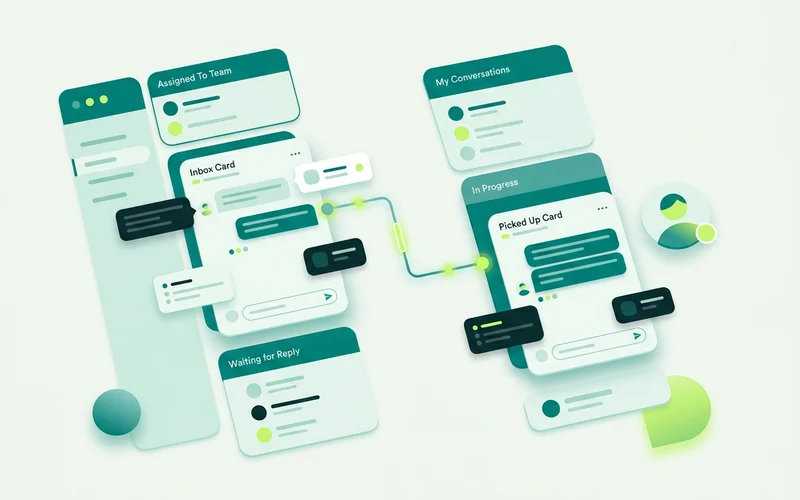
Whatever the AI does not handle needs to reach a person cleanly. In the Shared Team Inbox a handoff stops bot ownership and moves the conversation across with its history intact. From there it can be assigned to a teammate or returned to the queue, resolved and reopened, and searched later by contact details, messages, notes or tags.
Two features do more for a small team than their size suggests. Saved replies, personal or shared, let you insert a familiar answer into a draft and adapt it before sending, so the fifth version of a common reply takes seconds without going out unread. And append-only private notes carry the background between people without the visitor seeing any of it.
What this looks like after a month
The shape most small teams settle into: the AI answers a majority of first messages because a majority of first messages are repeats. Flows capture the enquiries that are going to become jobs. A person handles what is left, and handles it better, because they arrive with context instead of a cold start.
The team did not grow. The queue did not grow either.
Where to start tomorrow
Write down the ten questions you answered most often last month. Turn those into knowledge sources. Set grounding to Strict for anything involving price or availability, and write a refusal message that offers a route to a person rather than apologising. Build one flow: greeting, three choices, a form on the branch that usually turns into work, and an escalation.
That is an afternoon, and it removes the majority of the repetition. Everything after it is refinement.
What to measure once it is running
Three numbers tell you whether this is working, and none of them require a spreadsheet.
How many conversations reach a person. If the AI is handling the repeats, this should fall over the first month while total conversations stay flat or rise. That gap is the time you got back.
Coverage. The share of conversations that received a human response, including the unanswered ones. A falling handoff rate is only good news if the ones that do reach a person still get answered.
How complete the enquiries are. Harder to quantify, easy to feel. If your team has stopped opening conversations with three clarifying questions, the capture steps are doing their job.
Check these monthly rather than weekly. The signal takes a few weeks to separate from ordinary noise.
Where small teams usually go wrong
Adding the widget before the knowledge. An AI with nothing to work with refuses everything, and the team concludes the tool does not work. Load knowledge first.
Asking for too much, too early. A five-field form before any value has been given performs like a pop-up.
Leaving the offline path as an afterthought. Evening enquiries are often the highest-intent ones you get.
Never reading the transcripts. Fifteen minutes a month is the difference between a setup that improves and one that quietly ages.
None of these need extra headcount to fix. They need an hour of attention, once, and then occasionally.
Read next: what happens when the AI can’t answer, or shared team inbox vs a shared email address.
Questions people ask about this
Will AI replace the people on my team?
No. It handles the questions that already have an answer written down somewhere, which frees your team for the ones that need judgement. Every setup we recommend ends with a path to a person, because that is where the difficult conversations belong.
How does the team pick up a conversation?
Through the shared inbox. A handoff moves the conversation across with its history intact, including anything a flow captured, so whoever takes it reads the context instead of asking the visitor to repeat themselves.
What happens to questions the AI cannot answer?
In Strict mode it returns the refusal message you configured rather than guessing, and after a set number of refusals it hands off to a person. Turn limits, timeouts and provider errors escalate the same way.
Related guides
How to Add Live Chat to Any Website with a Script Snippet
Add website chat with a one-line script snippet. Where the snippet goes, generic steps for common site builders, the live/paused setting, and how to verify it loaded.
Read guideLive Chat vs AI Chatbot vs Contact Form: Which Does Your Site Need?
Compare live chat, AI chatbots and static contact forms for handling website enquiries, coverage, response speed and effort, and see how onmsg combines all three.
Read guideWhat Is Website Chat Software?
A plain-English guide to website chat software: what a chat widget does, how live chat, AI answers and guided flows differ, and where it fits for a small business.
Read guideWant to try this on your own site?
No credit card required.